PDA surgery: such a small vessel… that can cause so much pain
- Molly Benoît

- 5 days ago
- 3 min read
Understanding patent ductus arteriosus in companion animals
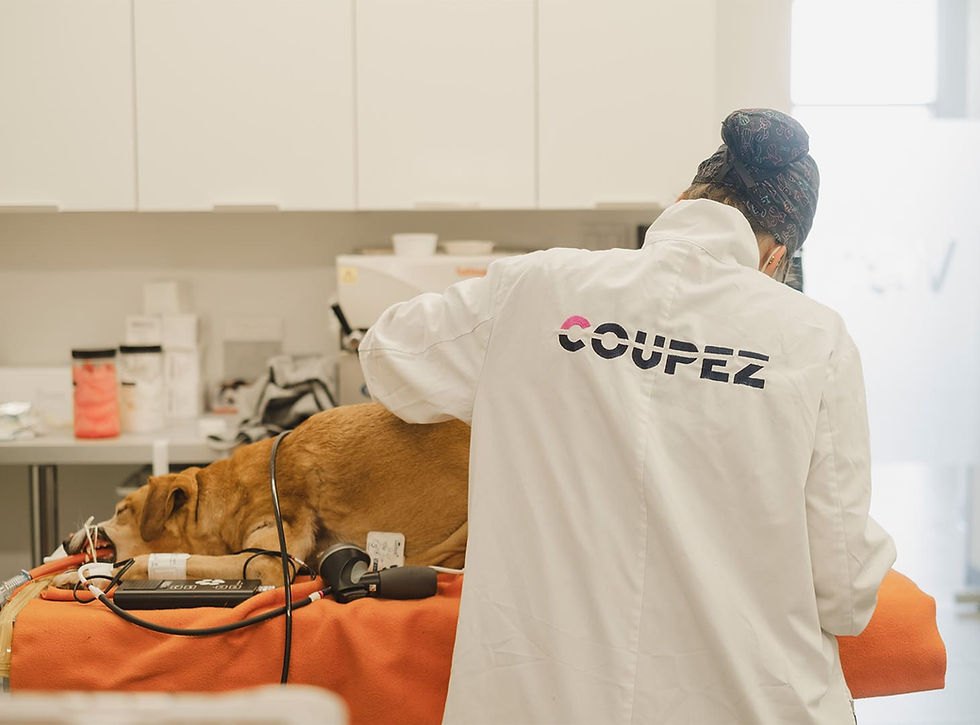
Coupez has just successfully performed his very first PDA (Persistence of the Ductus Arteriosus or arterial duct) surgery on the road, directly at one of our partner veterinary facilities.
This procedure, as complex as it is delicate, involves very precise anesthetic management and a highly meticulous surgical approach.
For us, this success represents much more than a medical feat: it reflects the fundamental values that led to the creation of Coupez: to offer specialized, accessible and mobile care , even for the most serious cardiac conditions.
In this article, discover:
How does the heart of a young animal work?
Why an untreated PDA represents a constant risk to patient survival
and how surgery can save the life of an affected animal.
A short biology lesson: understanding the role of the ductus arteriosus 🧬
In the fetus, the lungs are not yet functional. Oxygenated blood from the umbilical cord can therefore bypass the lungs. This is where the ductus arteriosus plays a crucial role:
➡️ It forms a direct link between the pulmonary artery and the aorta , allowing blood to be distributed rapidly throughout the body without passing through the immature lungs.
After birth, when the lungs expand, this channel is no longer needed and closes naturally within hours or days of the newborn's first breath.

When the canal doesn't close... 🔍
However, sometimes it persists; this is then called PDA . This congenital malformation leads to abnormal blood circulation, increases the workload of the heart, and can quickly lead to severe heart damage .
Premature animals are more at risk, but any puppy or kitten can be affected.
Warning signs to watch for 🩺
A young animal suffering from PDA may present with:
bluish mucous membranes (cyanosis),
low tolerance for exertion,
a very low energy level,
a heart murmur detected with a stethoscope.
In the presence of these signs, it is crucial to consult a veterinarian quickly and to have a complete cardiac examination (echocardiography, ECG) performed by a cardiologist.
Untreated PDA can significantly reduce life expectancy .
Why you absolutely shouldn't wait? ⏳
The longer a heart condition like PDA is allowed to progress, the more serious the consequences become. The heart has to work harder and harder, which leads to:
cardiac hypertrophy (thickening of the walls),
dilation of the heart,
premature cardiac fatigue ,
risk of congestive heart failure , sometimes as early as 1 or 2 years of age.
In some advanced cases, surgery is no longer possible because the heart is too damaged. Hence the importance of early diagnosis by a veterinarian and a prompt referral for cardiac surgery.
PDA surgery: a complex but life-saving procedure 🔧
PDA surgery is one of the most delicate procedures in veterinary medicine.
Highly specialized anesthesia 🛌
Anesthetic management presents a real challenge:
The available medications are limited.
Doses must be calculated with extreme precision (especially in very small patients),
The technicians must continuously monitor vital signs while maintaining optimal ventilation when the chest is open.
The surgical procedure 🔪
Opening of the chest between the 4th and 5th rib to access the heart.
Installation of a rib retractor to achieve perfect visibility.
Meticulous dissection of the ductus arteriosus, millimeter by millimeter.
Ligation of the PDA using a surgical thread made of silk.
Closure of the different layers of the thorax, placement of a drain and stabilization of the patient during anesthetic awakening.
This intervention literally changes the young animal's life: once the canal is closed, the heart can function normally and the life expectancy becomes comparable to that of a healthy animal.
❤️ A normal life thanks to surgery
Seeing a tiny animal recover after such delicate heart surgery is incredible. For our team, each PDA ligated represents a life saved, a future restored, and immense pride.
The Coupez team is ready to take on the next cardiac and orthopedic challenges that will arise, always with the same promise: to offer the greatest expertise while focusing our services on accessibility and above all, a total dedication to animal welfare.